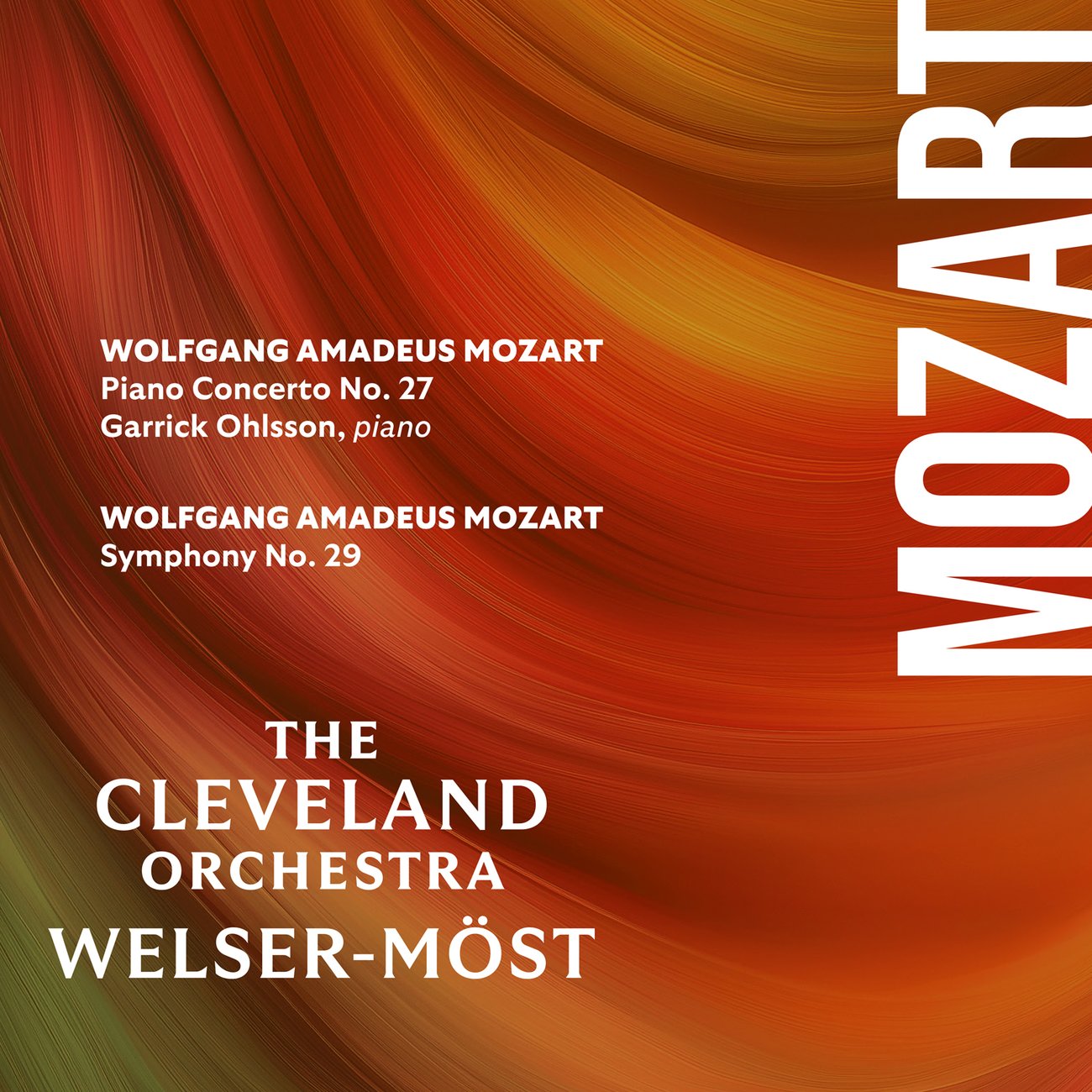
CLEVELAND— The Cleveland Orchestra and Music Director Franz Welser-Möst will release a new spatial audio recording of Mozart’s Piano Concerto No. 27, featuring pianist Garrick Ohlsson, paired with the composer’s Symphony No. 29, on August 1.
The recording is available exclusively on Apple Music Classical as part of a continued and growing partnership between The Cleveland Orchestra and the streaming platform. A wider release on all other digital streaming platforms will follow on September 12.
Captured live at Severance Music Center’s Mandel Concert Hall, the digital-only recording showcases the grace, clarity, and expressive brilliance of Mozart’s music from two distinctly different periods of his life.
Welser-Möst conducts both works, highlighting the elegance and precision that have defined his celebrated partnership with The Cleveland Orchestra. The works are also featured in two recent digital video productions on Adella.live, the digital home of The Cleveland Orchestra.
Mozart’s Piano Concerto No. 27 comes to life in the hands of Ohlsson, who is known for his remarkable interpretations and technical brilliance. A longtime favorite of Cleveland audiences, Ohlsson first gained international recognition after winning the 1970 Chopin International Piano Competition and has been captivating listeners ever since.
The concerto is paired with Symphony No. 29, which Mozart wrote at just 18 years old. Brimming with youthful energy and charm, the symphony stands in contrast to the calm beauty of the concerto.
The recording was produced by Elaine Martone, who earned her third Grammy Award for Classical Producer of the Year and her sixth Grammy overall earlier this year.
This project marks the Orchestra’s second recording release of 2025, following the March release of Julius Eastman’s Symphony No. 2 and Pyotr Ilyich Tchaikovsky’s Symphony No. 2. It is the 15th release on the Orchestra’s label since it launched in 2020.
Media Reviewing Access
Access to the recording’s audio files for media reviewing is available upon request. Album cover art, digital booklet, high-resolution images, and short video clips can be found in the recording press kit.
Recording Information
The Cleveland Orchestra
Franz Welser-Möst, conductor
Garrick Ohlsson, piano
Wolfgang Amadeus Mozart
Piano Concerto No. 27 in B-flat major, K. 595
Track 1 – I. Allegro
Track 2 – II. Larghetto
Track 3 – III. Allegro
Recorded March 14 to 17, 2024
Symphony No. 29 in A major, K. 201
Track 4 – I. Allegro moderato
Track 5 – II. Andante
Track 6 – III. Menuetto
Track 7 – IV. Allegro con spirito
Recorded October 5 to 7, 2023
Audio Production
Elaine Martone, recording producer
Gintas Norvila, recording, editing, and mixing engineer
Jennifer Nulsen, stereo mastering engineer
Alan JS Han, immersive mixing engineer
About Mozart’s Piano Concerto No. 27<> (by Hugh Macdonald)
This concerto is the last in Mozart’s incomparable series of piano concertos. He completed it on January 5, 1791, and entered the date in his catalog. It has been associated with the pianist Maria Magdalena Hofdemel, but the association is tenuous, since the one Vienna performance was given not by her but by Mozart himself on March 4, 1791, nine months before his death.
The concert became historic in many ways, being the last time Mozart played the piano in public. It was given in a restaurant across the street from his lodgings, and the soprano soloist who also took part was none other than Aloysia Weber, sister of Mozart’s wife, Constanze, and his adorata of some 12 years before.
Piano Concerto No. 27 is a strikingly serene work, even allowing for the brilliance always required in a concerto, with signs of a new level of maturity in Mozart’s style. Outwardly, the concerto resembles the composer’s others in its three balanced movements, judiciously placed cadenzas, and a tranquil middle movement of great beauty.
Mozart allows one bar of gentle introduction in the first movement (Allegro) and keeps a steadily pulsating tonic bass underneath the melody. A second theme presents a plain descending scale followed by the “same” scale modified with flat and natural signs. The movement’s development section is easily recognizable for moving through remote keys; the solo cadenza, on the other hand, stays close to the home key.
In the concerto’s slow movement (Larghetto), we observe the powerful contrast between extreme simplicity and sophisticated elegance, especially when the second violins and violas move into a winding inner line, a texture Mozart had frequently used since his earliest works.
The finale (Allegro) is a rondo, essentially a series of variations alternating with a main melody. Here, however, solo cadenzas twice hold up the return of the theme. The one point where the theme appears in the “wrong” key is clearly prominent, if only because the pretense cannot be sustained for long.
Overall, Mozart’s final piano concerto leaves the clear impression that his invention would have kept bubbling in a similarly wondrous vein for many years to come, had fate spared his early death. Still, the concertos we have are numerous enough — and rich enough in invention — to give us little possible ground for regret.
About Mozart’s Symphony No. 29 (by Hugh Macdonald)
The date inscribed at the head of the autograph score of this symphony (April 6, 1774) was later crossed out, leaving us a bit of a mystery. The 18-year-old Mozart probably intended the symphony for a performance in Salzburg at that time, although no record of one survives. In January 1783, Mozart asked his father to send the symphony to him in Vienna, so it is likely to have been performed at that time.
What composer, after all, could lay aside and forget so profound and yet so simple a work as this? It has the intimacy of chamber music (only oboes and horns support the strings) with the drive of symphonic music. All four movements are on an equally high level, and from the very opening measures, listeners are aware of the confidence and effortless craft that imbue every page of the symphony.
At the top of the first movement (Allegro moderato), there is a plunging octave from the first note to the second, with this simplest interval full of hidden wealth and weightless harmonies that float beneath it. This is a striking opening to a symphony — no brassy fanfare here as a call to attention. Mozart follows it with lighter passages and simpler themes, but the tone is set.
The second movement (Andante) moves comfortably forward over a gently striding bass. The second violins are almost as important as the firsts in this luxurious movement, with a lovely coda added at the end. A special touch is found here — the oboes and horns attempt the main theme on their own for the first time, giving the violins time to discard their mutes for their final statement.
The dotted rhythms of the third movement (Menuetto) might be regarded as playful, except that a more ferocious use is found for them immediately after the end of the first section. The movement’s more relaxed Trio section has been compared to Chopin for its graceful style.
The plunging octave of the opening returns to launch the fourth movement (Allegro con spirito), and again the second violins maintain their near equality with the firsts. There is a coda here as well, an extension that Mozart seems to have been especially fond of at this point in his life. But then, he almost always seemed to have one more point to make, and to have found a way to make it with the utmost clarity and force.
About The Cleveland Orchestra
The Cleveland Orchestra, under the leadership of Franz Welser-Möst since 2002, is one of the most sought-after performing ensembles in the world. Year after year the ensemble exemplifies extraordinary artistic excellence, creative programming, and community engagement. In recent years, The New York Times has called Cleveland “the best in America” for its virtuosity, elegance of sound, variety of color, and chamber-like musical cohesion.
Founded by Adella Prentiss Hughes, the Orchestra performed its inaugural concert in December 1918. By the middle of the century, decades of growth and sustained support had turned the ensemble into one of the most admired around the world.
The past decade has seen an increasing number of young people attending concerts, bringing fresh attention to The Cleveland Orchestra’s legendary sound and committed programming. More recently, the Orchestra launched several bold digital projects, including the streaming platform Adella.live and its own recording label. Together, they have captured the Orchestra’s unique artistry and the musical achievements of the Welser-Möst and Cleveland Orchestra partnership.
The 2025–26 season marks Franz Welser-Möst’s 24th year as Music Director, a period in which The Cleveland Orchestra has earned unprecedented acclaim around the world, including a series of residencies at the Musikverein in Vienna, the first of its kind by an American orchestra, and a number of acclaimed opera presentations.
Since 1918, seven music directors — Nikolai Sokoloff, Artur Rodziński, Erich Leinsdorf, George Szell, Lorin Maazel, Christoph von Dohnányi, and Franz Welser-Möst — have guided and shaped the ensemble’s growth and sound. Through concerts at home and on tour, broadcasts, and a catalog of acclaimed recordings, The Cleveland Orchestra is heard today by a growing group of fans around the world. Find out more.
About Franz Welser-Möst
For 24 years, Franz Welser-Möst has shaped an unmistakable sound culture as Music Director of The Cleveland Orchestra. Under his leadership, the Orchestra has been repeatedly praised by international critics for its musical excellence, continued its strong commitment to new music, and brought opera back to the stage of Severance Music Center. Through innovation and cooperation, the Orchestra also founded its own streaming platform (Adella.live) and now has one of the youngest audiences in the US.
In addition to residencies in the US, Europe, and China, Welser-Möst and the Orchestra are regular guests at all the major international festivals. Welser-Möst will remain Music Director until 2027, making him the longest-serving music director of The Cleveland Orchestra.
Welser-Möst enjoys a particularly close and productive artistic partnership with the Vienna Philharmonic. He regularly conducts the orchestra in subscription concerts at the Vienna Musikverein, at the Salzburg Festival, and on tour in Europe, Japan, China, and the US, and has appeared three times on the podium for their celebrated New Year’s Concert (2011, 2013, and 2023). At the Salzburg Festival, Welser-Möst has set new standards in interpretation as an opera conductor, with a special focus on the operas of Richard Strauss.
Welser-Möst has been the recipient of several major honors and awards, including the Honorary Membership of the Vienna Philharmonic, bestowed upon him in 2024.
About Garrick Ohlsson
Since his triumph as winner of the 1970 Chopin International Piano Competition, pianist Garrick Ohlsson has established himself worldwide as a musician of magisterial interpretive and technical prowess. Although long regarded as one of the world’s leading exponents of the music of Frédéric Chopin, Ohlsson commands an enormous repertoire that ranges over the entire piano literature, encompassing more than 80 concertos.
Recent engagements include an appearance with the Orpheus Chamber Orchestra at Carnegie Hall, performances with orchestras in Portland, Madison, Kalamazoo, Palm Beach, and Fort Worth, and recital programs — featuring works from Beethoven, Schubert, and Chopin to Barber and Scriabin — in Santa Barbara, Orange County, Aspen, Warsaw, and London.
Collaborations with the Cleveland, Emerson, Tokyo, and Takács string quartets — in addition to numerous orchestras and conductors — have led to decades of touring and recordings. His solo recordings are available on the British label Hyperion and in the US on Bridge Records. Both Brahms concertos and Tchaikovsky’s Second Piano Concerto have been released on live recordings with the Melbourne and Sydney symphonies, as well as Rachmaninoff’s Third Piano Concerto with the Atlanta Symphony Orchestra and Robert Spano, all on their own labels.
A native of White Plains, New York, Ohlsson began piano studies at age 8 at the Westchester Conservatory of Music, and at 13, he entered The Juilliard School in New York. He was awarded the Avery Fisher Prize in 1994 and the University Musical Society Distinguished Artist Award in Ann Arbor, Michigan, in 1998. Ohlsson is the 2014 recipient of the Jean Gimbel Lane Prize in Piano Performance from the Northwestern University Bienen School of Music, and in August 2018, the Polish Deputy Culture Minister awarded him the Gloria Artis Gold Medal for cultural merit. He is a Steinway Artist and makes his home in San Francisco.
About Apple Music Classical
Apple Music Classical, the world’s leading classical music app, is a dedicated music streaming app designed specifically for classical music lovers and musicians. The app provides users with access to the world’s largest classical music catalog, with fully optimized search, and allows them to enjoy the highest audio quality available and experience many classical favorites in new ways with immersive Spatial Audio. Additionally, users can browse expertly curated playlists, insightful composer biographies, and descriptions of thousands of works, including many recent and historical Cleveland Orchestra recordings.
Apple Music Classical received its most significant update since launch this March, introducing a number of exciting new features, including Listening Guide, personalized recommendations, and editorial stations. Additionally, Apple Music Classical was recently brought to the web, giving every customer the ability to listen and enjoy on any desktop and mobile device, a feature recognized as crucial to the classical music community.
Exclusive to the app, Listening Guide is an innovative new feature that takes users inside a notable piece of music as they listen, highlighting details and explaining the work in real time as it unfolds phrase by musical phrase. Available now for 100 editorially selected pieces, notes from Apple Music’s
classical experts help listeners identify instruments and follow the stories behind the music. Listening Guide is available in English, French, German, Japanese, Korean, and Simplified Chinese.
# # #
Media Contacts:
(United States)
Christophe Abi-Nassif, The Cleveland Orchestra, cabinassif@clevelandorchestra.com, 216-231-7441
Jen Steer, The Cleveland Orchestra, jsteer@clevelandorchestra.com, 216-231-7637
Amanda Ameer, First Chair Promotion, amanda@firstchairpromo.com, 212-368-5949
(United Kingdom and other international territories)
Katy Rogers-Davies, LSO Live Marketing & Partnerships Manager, Katy.Rogers-Davies@lso.co.uk, +44 20 7382 2543
|